


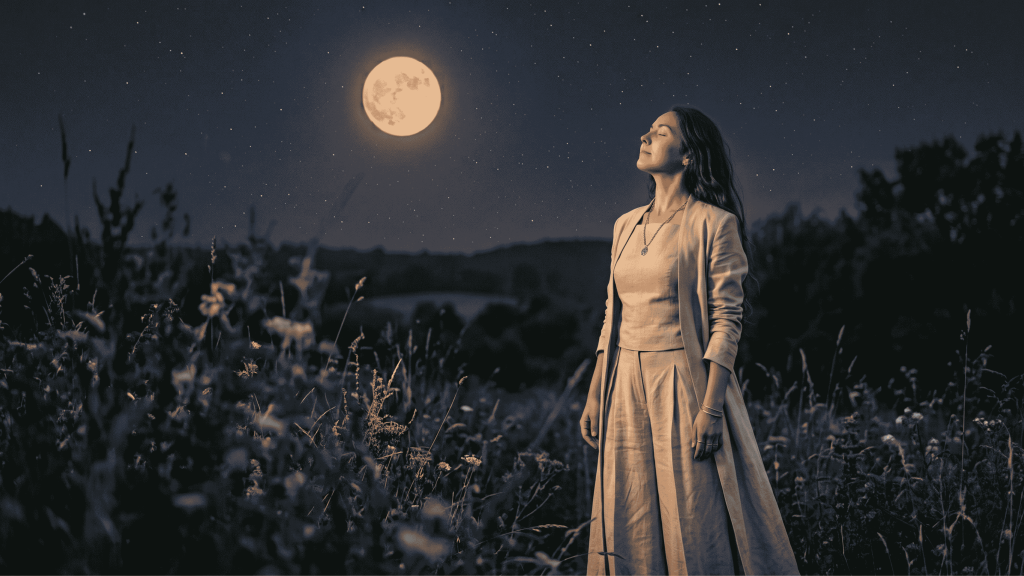
“Bipolar.” “Too emotional.” “Hysterical.” These words have been affixed to women’s bodies like diagnoses, verdicts handed down without appeal every time their energy fluctuated, their mood shifted colour, their appetite for the world stretched and contracted like the tide. They were taught to apologise for it. To correct it. To display a constancy their physiology never intended.
What is called “instability” bears a different name: cyclicity. And cyclicity is a form of intelligence, a magic of living things. For what could be more remarkable than a body that, each month, regenerates itself? That weaves a brand-new nest with clockwork precision, in case life might choose to settle there? And that, when life does not arrive, carries out its own renewal in a gesture as ancient as the world itself, tirelessly, faithfully. In all of human biology, there is no mechanism more elaborate, nor more quietly extraordinary.
The Sacred Feminine does not oppose science. It precedes it, completes it and gives it a human face. Because what ancestral traditions have always known intuitively, modern endocrinology now confirms with precision: the female body operates on a cycle of four distinct phases, each governed by a different hormonal balance, each carrying specific cognitive, creative and emotional capacities. Learning to recognise them means ceasing to fight against oneself. It means becoming multipotential.
Sacred Feminine: a philosophical and physiological approach that recognises female cyclicity as a cognitive, creative and emotional resource. It is organised around four distinct hormonal phases, each inhabited by specific qualities. Menstrual cycle: the hormonal sequence lasting an average of 28 days (ranging from 21 to 35 days depending on the individual), organised into the menstrual, follicular, ovulatory and luteal phases. Lunar cycle: the poetic and traditional name for the menstrual cycle, whose average duration roughly corresponds to the cycle of the Moon. A synchrony explored by Miranda Gray, Alexandra Pope and Christiane Northrup.
The Sacred Feminine is that force which connects us to our deepest essence, to our intuition and our creativity. It is an invitation to embrace all facets of our being and to live our femininity fully.
Élodie Baron · integrative psychotherapist and sex therapist, Intima Formations
The Sacred Feminine: a cyclic intelligence
The Sacred Feminine designates the very essence of the feminine in all its power and beauty: creative force, intuitive wisdom, cyclicity embraced as a resource, unconditional love of the self. Its roots extend to the oldest traditions, where goddesses were venerated as symbols of fertility, wisdom and power, and where the feminine was associated with the Earth Mother, source of all life and abundance.
Several contemporary figures have formalised this intuitive knowledge into concrete tools. Miranda Gray, author of Red Moon (1994), was the first to map the four lunar archetypes of the female cycle in their mythopoetic dimension, laying the foundations for reading the cycle as a monthly initiatory journey. Alexandra Pope and Sjanie Hugo Wurlitzer, authors of Wild Power (2017), developed the “cycle wheel” as an operational tool, now used by therapists and women around the world. Christiane Northrup, gynaecologist and author of Women’s Bodies, Women’s Wisdom (1994, reissued), has spent decades documenting the impact of cyclicity on physical and emotional health, laying the groundwork for an integrative feminine medicine. These works converge on a single principle: the menstrual cycle is not an inconvenience to be managed. It is a compass to be read.
The philosophy of the Sacred Feminine invites a form of profound reconciliation: accepting oneself with one’s strengths and shadow areas, reconnecting with natural rhythms, honouring fluctuations as messages rather than defects. It is less a spirituality than an inner ecology: an art of living that reconnects each woman to what her body already knows.
It expresses itself through four archetypes, which are not roles to be performed, nor boxes to be forced into. They are qualities that pass through every woman each month, in a precise order, with a hormonal logic that science has at last been able to map.
The hormonal map: what science confirms
Behind every archetype lies a chemistry. Behind every energy shift, a precise hormonal balance. Understanding this map takes nothing away from the magic of the cycle: it simply makes it legible.
Oestrogen, the hormone of openness, momentum and connection, rises progressively from the early days of the cycle and reaches its peak at the moment of ovulation, before declining to give way to progesterone. Progesterone, in turn, is the hormone of inwardness, warmth and slowdown: it dominates the second half of the cycle, preparing the body for a potential of gestation or, in the absence of fertilisation, for the menstrual renewal that will follow. Testosterone, present at more discreet levels, experiences a brief surge around ovulation, amplifying desire, confidence and risk appetite. In the background, FSH (follicle-stimulating hormone) and LH (luteinising hormone) orchestrate follicular maturation and the trigger of ovulation.
These variations shape brain functioning, emotional sensitivity, sleep quality, stress resilience and cognitive capacities. Research conducted at the Karolinska Institut and published in the Journal of Neuroscience shows that performance in verbal fluency and working memory is significantly higher in the follicular phase, when oestrogen is rising. Studies published in Archives of Women’s Mental Health confirm that stress sensitivity is neurologically amplified in the luteal phase. This is not irrationality: it is a nervous system operating in a different regime.
Knowing this map means having an inner compass of remarkable precision. It means understanding that fluctuations are not flaws: they are information.
A reality worth naming: women using hormonal contraception (the pill, vaginal ring, implant, hormonal IUD) do not experience a natural cycle in the endocrinological sense. The four phases described in this article presuppose a spontaneous ovulatory cycle. For women using hormonal contraception, cyclicity can nonetheless be cultivated differently: by synchronising with the lunar cycle, observing variations in energy and sensitivity independently of the hormonal cycle, or consulting their doctor to explore non-hormonal alternatives if they wish to reconnect with their natural cycle. Dr Sarah E. Hill, author of This Is Your Brain on Birth Control (2019), has documented the impact of hormonal contraception on cognition, emotional sensitivity and female sexuality: essential reading for understanding the influence of one’s own chemistry on lived experience.
The hormonal map: what science confirms
Each month, from the first period to the last, women pass through four distinct phases, each inhabited by a particular quality of energy. These four seasons compose the complete cycle of the Sacred Feminine.
The Wise Woman · Menstrual phase, days 1-7
Oestrogen and progesterone are at their lowest levels. The veil between the conscious and unconscious thins. Neuroscience shows heightened activation of the default mode network: the neural network associated with introspection, pattern recognition and autobiographical memory. This is the time of the Wise Woman, of deep knowing, of gathering inward.
This is not the moment to conquer the external world. It is the moment to listen to what is happening within. Scheduling decisive meetings or complex accounting in this window means working against one’s own biology. It is, rather, a precious time for strategic reflection, intuitive writing, reviewing what deserves to be kept. The Wise Woman sees what the other phases cannot yet perceive.
Medical reference · Hormonal profile: days 2-4 constitute the standard window for FSH, LH and oestradiol, faithfully reflecting ovarian reserve and cycle health. Full blood count and serum iron: avoid days 1-5; prefer days 7-10 for a reading that accurately represents iron stores.
Ally plants of the Wise Woman · In traditional Chinese medicine, the menstrual phase is the time of Blood (Xue) movement: favouring the circulation of Qi-Blood and draining the Liver. Yarrow (Achillea millefolium) regulates flow and eases cramping. Nettle (Urtica dioica) remineralises after bleeding: rich in iron, magnesium and zinc. Raspberry leaf (Rubus idaeus), a traditional uterine tonic, prepares the lining for the next cycle. Take as an infusion, preferably on days 1-5.
The Mother · Ovulatory phase, days 14-17
Oestrogen reaches its peak. Testosterone makes a brief and significant appearance. Oxytocin flows abundantly. A study conducted at the University of Vienna showed that empathy, social cognition and emotional availability reach their zenith within this four-day window. The Mother radiates because her body biologically equips her to do so: she is magnetic, present, inhabited by a natural generosity.
This is the moment to welcome: major meetings, family gatherings, important conversations with those we care about. It is no coincidence that women feel “at their best” during this phase: they are, chemically. Receiving the entire in-law family during the Enchantress phase can lead to diplomatic incidents. Receiving them during the Mother phase means transforming the occasion into a moment of genuine connection.
Ally plants of the Mother · In traditional Chinese medicine, ovulation is the moment of Yin transforming into Yang: Qi is in full movement, creative energy at its peak. Damiana (Turnera diffusa), known for amplifying libido and vital momentum, ideally accompanies this time of maximum radiance. Hibiscus, rich in anthocyanins, supports circulation and the joy of the heart. Rose in all its forms (infusion, hydrosol, floral water) honours the emotional and sensory dimension of this phase of maximum openness.
The Enchantress · Luteal phase, days 18-28
Progesterone takes the reins. Basal body temperature rises. Sleep shifts. Sensitivity to cortisol intensifies: the smallest external stress resonates more loudly, accumulated frustrations rise to the surface, injustices become unbearable. This is not because something “is going wrong”: it is because the nervous system is operating in a mode of heightened perception. The Enchantress sees clearly. She perceives what the Maiden and the Mother might have preferred not to examine.
This emotional storm has a precise neurochemical explanation. Progesterone binds to GABA receptors, the brain’s primary inhibitory system and natural regulator of calm and emotional balance. Its decline at the end of the luteal phase deprives the brain of an essential stabiliser. Simultaneously, fluctuations in oestrogen disrupt serotonin and dopamine, the neurotransmitters of mood and pleasure. This mechanism is identical, amplified, to the one found during perimenopause: this is no coincidence. Intense premenstrual sensitivity may prefigure a heightened sensitivity to the great hormonal transition. Understanding the one already means preparing better for the other.
Poorly accompanied, this phase produces premenstrual syndrome in all its virulence: irritability, fatigue, a sense of being overwhelmed. Well understood, it reveals a rare capacity: that of perceiving what is not right, of feeling what demands attention, of creating from the depths. Artists, writers and therapists often know this truth instinctively.
The body is more reactive during this phase. Skin may be more sensitive, intimate areas more delicate. Offering the body a sensual, mindful gesture of care, not out of obligation, as a deliberate choice: means transforming the Enchantress phase into a ritual of self-regulation as much as of exploration.
Ally plants of the Enchantress · In traditional Chinese medicine, the luteal phase warms the inner Yang (Ming Men, the Gate of Life) and supports Kidney Yang. Chasteberry (Vitex agnus-castus), acting on the hypothalamic-pituitary axis, is the most thoroughly documented plant for supporting progesterone-oestrogen balance and calming PMS. Valerian (Valeriana officinalis) promotes sleep and calms the nervous system. Saffron (Crocus sativus), studied for its action on serotonin, has shown significant effects on mood during the luteal phase in several controlled clinical trials. Magnesium (not a plant, an essential mineral) reduces cramping, water retention and PMS irritability: to be supplemented from day 14 onwards for women with marked premenstrual symptoms.
As Élodie Baron puts it: “It is not a matter of whim or convenience. It is a matter of effectiveness and self-respect. The Enchantress invites us to look at what is, with honesty and without drama. It is a gift, if one consents to receive it.”
Adapting your life to the cycle: the practice of the Sacred Feminine
The Sacred Feminine is not a contemplative concept. It is profoundly operational. Accepting that one is traversed by these four phases means becoming multipotential: capable of aligning one’s schedule with one’s biology rather than in response to external injunctions towards linear performance.
Planning a sales presentation or a job interview in the follicular phase, reserving detailed analysis and strategic reflection for the menstrual phase, welcoming major social occasions in the ovulatory phase and creating space for solitude and creativity in the luteal phase: this is not weakness, it is intelligent organisation. It means working with one’s brain rather than against it.
This is learnable. It requires first observing, noting, noticing. Then adjusting. Then trusting what one feels. The body, when listened to, is extraordinarily consistent.
Applications such as Clue, Flo or Natural Cycles allow one to track the cycle and anticipate phases. Beyond digital tools, keeping a cycle journal remains the most powerful instrument: noting each day one’s energy level, dominant emotions, sleep quality and inclinations or resistances allows one, within two or three cycles, to identify personal patterns with a precision no application can anticipate.
Menstrual cycle and health: the medical guide to planning your tests
The menstrual cycle is a window of medical information that conventional medicine underutilises. Knowing when to have tests carried out means obtaining data that faithfully reflects the body’s reality and avoiding erroneous conclusions. The references integrated in each archetype section specify the tests associated with each phase. What follows are complementary data points that the individual phases do not cover separately.
Serum iron and haemoglobin merit particular attention. Menstruation induces a temporary depletion that can skew results during the first days of the cycle. Days 7-10 provide a reading representative of actual iron stores. Ferritin, being more stable, can be measured at any point outside the active menstrual period.
Serum progesterone is measured on day 21, or seven days before the next period for irregular cycles. This is the only moment that confirms whether ovulation has actually taken place.
Inflammatory markers are physiologically slightly elevated in the luteal phase. In women with autoimmune conditions, a blood draw at end of cycle can overestimate inflammatory activity. The follicular phase gives a more reliable reading.
The first moons: transmitting the intelligence of the cycle
The arrival of the first period is a threshold. In many ancestral cultures, this moment was celebrated as an initiation: an entry into the world of women, an awakening to cyclic power. In contemporary Western culture, it is most often received with a packet of sanitary towels and advice not to speak of it too openly. This first cycle deserves more.
Offering a girl the language of cyclicity rather than that of discomfort or constraint means handing her a map she will be able to use throughout her life. It means telling her: your body is not capricious. It is wise. And so will you be, in your own way.
The first period typically arrives between the ages of 11 and 14, and the first cycles are often irregular: this is normal. The hormonal axis is in a phase of calibration and may take one to three years to find its regularity. This irregularity is not a dysfunction to be treated, unless it is accompanied by very intense pain, extremely short or very long cycles, or an absence of periods for more than three consecutive months: in these cases, a gynaecological consultation is recommended to rule out endometriosis, polycystic ovary syndrome or other treatable causes.
Speaking to a girl about her cycle also means speaking to her about the four phases and their qualities: explaining to her that she is not “too emotional” at the end of the cycle, that she is not “out of herself” when she wants to withdraw from the world, that she is not “unstable” when her energy fluctuates. These words, transmitted early, have the power to profoundly change the relationship a woman holds with herself for decades.
Perimenopause and menopause: the sacred transformation
Perimenopause and menopause are initiatory passages, profound transformations that mark a new chapter in a woman’s life. Far from being an ending, this is a rebirth. The woman traversing the menopause has acquired and assimilated all the qualities of the four archetypes. The Wise Woman, the Maiden, the Mother, the Enchantress: she carries them all within herself, distilled into a wisdom that the cycle no longer needs to orchestrate each month in order to express itself.
In Japanese tradition, women at the menopause are considered liberated women: freed from the constraints of fertility, they can devote themselves fully to their own development and their role of transmission within the community. This vision stands in radical contrast to the Western one, which has long associated the menopause with decline and the loss of femininity. Re-reading this milestone through the prism of the Sacred Feminine means restoring to it what it is: an opportunity for rebirth and flourishing.
The hormonal transition of perimenopause is often accompanied by changes in intimate physiology: variations in vaginal pH, heightened sensitivity, dryness, shifts in natural balances. These signals from the body call for care designed to accompany these new frontiers. To explore the hormonal science of this great transition in depth, read our dedicated article: The Great Transition, what no one probably told you about perimenopause.
Living the Sacred Feminine each day: rituals, body and reconnecting to the cycle
Connecting to the Sacred Feminine requires no extraordinary amount of time. It requires a quality of attention. Along with a few simple practices, anchored in regularity rather than intensity.
The cycle journal is the founding practice. Each day, noting in a few words one’s energy level, dominant mood, sleep quality, inclinations or resistances. Within two or three cycles, patterns of surprising clarity emerge. This journal becomes a faithful mirror, more precise than any application, because it is subjective: it captures what data cannot measure.
Meditation and moments of silence offer the inner space needed to perceive the fluctuations of the cycle even before they manifest physically. For those daunted by formal meditation, cultivating moments without music, without a screen, without an agenda produces comparable effects. Silence is in itself an instrument of reconnection.
Embracing your cycle: an intelligence to cultivate
The Sacred Feminine is not an ideology. It is an invitation: to cease pathologising what is, in reality, a cyclic intelligence of remarkable precision. An intelligence inherited from millions of years of evolution, inscribed in every cell, refined by every generation of women who lived it before us. It has never asked to be corrected. It has always asked to be understood.
Embracing one's cycle means ceasing to see oneself as defective and beginning to recognise oneself as multipotential. Every phase is a capacity. None is a flaw.
Élodie Baron
This cycle has been moving through you since your first moon. It will continue to inform you, to guide you, to offer its varying qualities until the transformation of the menopause and beyond. The magic does not stop. It simply changes form.
References & Experts
Élodie Baron, integrative psychotherapist, sex therapist and academic director, Intima Formations · intima-formations.fr
Miranda Gray. Red Moon: Understanding and Using the Creative, Sexual and Spiritual Gifts of the Menstrual Cycle. White Owl, 1994.
Alexandra Pope & Sjanie Hugo Wurlitzer. Wild Power. Hay House, 2017.
Christiane Northrup, M.D. Women’s Bodies, Women’s Wisdom. Bantam Books, 1994 (reissued 2020).
Dr Sarah E. Hill. This Is Your Brain on Birth Control. Avery, 2019.
Maisie Hill. Period Power. Green Tree, 2019.
Sundström Poromaa I., Gingnell M. Menstrual cycle influence on cognitive function and emotion processing. Frontiers in Neuroscience, 2014.
Eisenlohr-Moul T.A. et al. Toward the reliable diagnosis of DSM-5 premenstrual dysphoric disorder. Archives of Women’s Mental Health, 2016.
Lopresti A.L., Drummond P.D. Saffron (Crocus sativus) for depression: a systematic review. Human Psychopharmacology, 2014.
Hammarström A. et al. A conceptual framework for gender research in medicine. Gender Medicine, 2014.
de Jonge X. et al. The menstrual cycle and sport performance. Sports Medicine, 2019.
Epperson C.N. et al. Premenstrual dysphoric disorder. American Journal of Psychiatry, 2012.
* * *
Transparency note · Claude assisted in structuring this article and identifying the scientific sources. The philosophy, the perspective on female cyclicity and the convictions that run through these pages remain entirely those of HedonX.
This article was born from a simple conviction: women deserve to understand what is happening within them, with the right words and the science to support them. This is not a luxury. It is a necessity.
Sophie · Founder, HedonX